


Hacking is the unauthorized access or manipulation of computer systems, networks, or data to bypass security measures. For most people, hearing the term brings up anxiety about stolen passwords, compromised devices, and drained bank accounts. The root cause usually comes down to weak personal security habits combined with overlooked software flaws that attackers actively scan for. Understanding what hacking is removes the fear and replaces it with practical awareness. In this guide, you will learn exactly who is behind these breaches, the most frequent attack methods used in 2026, and the realistic steps you can take to protect your digital privacy.
Quick Answer
Hacking is the unauthorized access or manipulation of computer systems and networks. It usually happens when attackers exploit weak passwords, outdated software, or human error through tactics like phishing. The fastest way to stay safe is to enable multi-factor authentication and keep all software updated.
What Is Hacking?
At its core, hacking involves finding and exploiting vulnerabilities in a system to gain access to data or functions that are meant to be restricted. This can range from guessing a weak password to writing complex code that takes advantage of a flaw in an operating system.
While mainstream media uses the word almost exclusively as a negative term, the technical definition is neutral. Security professionals hack into their own company's servers daily to find weak points before criminals do. The process relies on understanding how systems are built and identifying where the logic breaks down. People use these techniques for various reasons: financial gain, corporate espionage, political activism, or simply the intellectual challenge of breaking a puzzle. In the context of cyber threats, it refers to the malicious bypassing of your digital defenses.
Myths About Hacking
A common misconception is that hackers are always lone teenagers in dark basements. In reality, modern hacking is largely driven by highly organized, well-funded criminal syndicates. Another myth is that Apple devices cannot be hacked. While macOS and iOS have strong built-in security, they are still vulnerable to phishing, zero-day exploits, and physical access attacks. Finally, many believe hackers only target large corporations. In truth, automated scripts scan the entire internet for easy targets, meaning everyday users are breached constantly.
History of Hacking
The concept of hacking originated in the 1960s at MIT, where members of the Tech Model Railroad Club used the term to describe optimizing systems and pushing technology beyond its intended limits. It was a positive, creative pursuit.
The shift toward malicious activity began in the 1980s as personal computers became common. The release of the Morris Worm in 1988—one of the first computer worms distributed via the internet—highlighted how interconnected systems could be disrupted. Through the 1990s and 2000s, the rise of the internet transformed hacking from a niche hobby into a massive criminal enterprise. Today, it is a permanent fixture of the digital landscape, split sharply between malicious exploitation and defensive cybersecurity.
Why Hacking Happens
Understanding why systems get compromised requires looking at the root causes rather than just the symptoms.
Wrong habits
Reusing the same password across multiple accounts creates a single point of failure. When one database leaks, attackers use those credentials on banking, email, and social media accounts.
Outdated tools/info
Running legacy software or ignoring system updates leaves known security patches unapplied. Attackers maintain databases of older vulnerabilities and actively scan the internet for systems that haven't caught up.
Misunderstanding system
Users often misconfigure cloud storage, leave default router settings active, or adjust privacy settings without understanding the implications, accidentally exposing their data to the public internet.
External limitations
Even highly secure systems face zero-day vulnerabilities. These are flaws in the code that the software creator doesn't know about yet, meaning there is no patch available when an attacker discovers it.
How Hacking Works
Most cyberattacks follow a structured lifecycle known as the cyber kill chain. To fully understand how hacking works, it helps to look at these steps. It rarely involves typing furiously at a black screen like in the movies.
It starts with Reconnaissance, where the attacker gathers publicly available information about a target, such as email addresses or software versions. Next is Weaponization, where they pair an exploit with a payload (like a virus). During Delivery, they send the payload via a phishing email or compromised website. Exploitation occurs when the victim interacts with the payload, triggering the hack. The attacker then Installs persistent access tools, establishes Command and Control to communicate with the infected machine, and finally takes Action on Objectives, which means stealing data or demanding a ransom.
Types of Hackers
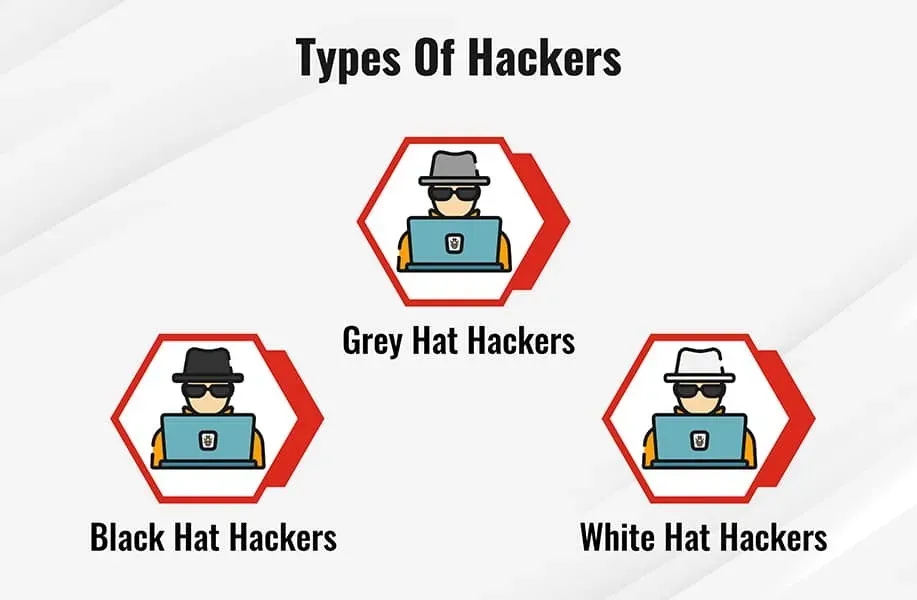
The information security community generally categorizes the different types of hackers into three distinct groups based on their intent and the legality of their actions.
1. White Hat Hackers
White hat hackers, often called ethical hackers, are cybersecurity professionals who use their skills to improve system defenses. They work directly for organizations or as independent consultants to simulate real-world attacks.
- What it is: Authorized security testing performed to find and fix vulnerabilities.
- Why it matters: They prevent data breaches by catching flaws before malicious actors do.
- Who uses it: Corporations, government agencies, and healthcare organizations with strict compliance requirements.
- Strengths: They operate legally, document their findings clearly, and provide actionable fixes.
- Limitations: They are limited by the scope of their contract and cannot always predict the unpredictable nature of a real, motivated criminal.
- Beginner suitability: Ethical hacking is a highly accessible and rewarding career path for beginners interested in cybersecurity.
2. Black Hat Hackers
These are the threat actors most people picture when they hear the word hacker. They operate illegally, motivated by financial gain, revenge, or occasionally nation-state directives.
- What it is: Unauthorized access to systems to steal data, deploy ransomware, or cause disruption.
- Why it matters: They are the direct source of identity theft, financial fraud, and operational downtime for businesses.
- Who uses it: Cybercriminal syndicates, lone wolves, and state-sponsored advanced persistent threat (APT) groups.
- Strengths: They are highly motivated, well-funded, and constantly innovating to bypass modern security.
- Limitations: They face severe legal repercussions if caught, forcing them to operate through complex anonymization networks.
- Beginner suitability: N/A. This is illegal activity with severe penalties.
3. Gray Hat Hackers
Gray hat operators exist in the middle ground. They hack without explicit permission but usually do not have malicious intent. They might find a vulnerability in a company's system and report it, often asking for a fee or simply publishing it publicly to force a fix.
- What it is: Unauthorized system penetration done without malicious intent, often to prove a point.
- Why it matters: They expose real-world flaws that organizations were ignoring, forcing improvements in digital infrastructure.
- Who uses it: Independent security researchers, activist groups, and hobbyists.
- Strengths: They have the technical skills of black hats but lack the destructive motives.
- Limitations: Their methods are still illegal in most jurisdictions, and they can cause unintended system instability or legal trouble for themselves.
- Beginner suitability: Highly discouraged for beginners, as crossing the line from research to illegal access is easily done and harshly punished.
Common Hacking Techniques
Attackers rely on a consistent set of methods to breach systems. Understanding these vectors is the most effective way to recognize a threat before it causes damage.
1. Phishing Attacks
Phishing remains the most successful attack method because it targets human psychology rather than software code. Attackers send deceptive emails or text messages designed to look like legitimate communications from banks, service providers, or coworkers. These messages create a false sense of urgency, pushing the victim to click a link and enter credentials on a fake login page. The defense against phishing relies entirely on user awareness and verification. If you want to understand the exact mechanics of these deceptive campaigns, reading this dark web phishing guide provides a solid breakdown of how threat operators build their traps.
2. Malware and Ransomware
Malware refers to any malicious software designed to harm a device or network. Ransomware is a specific, highly destructive subset that encrypts the victim's files and demands payment for the decryption key. Attackers deliver malware through infected email attachments, malicious downloads, or by exploiting unpatched software. Once inside, it can log keystrokes, steal files, or lock down an entire corporate network. Recovering from ransomware often requires complete system wipes and restoring from backups, making prevention through endpoint security software critical.
3. DDoS Attacks
A Distributed Denial of Service (DDoS) attack does not steal data. Instead, it aims to take a website or service offline. Attackers use a network of compromised computers (a botnet) to send an overwhelming amount of traffic to a target server all at once. The server becomes exhausted trying to process the fake requests, causing it to crash for legitimate users. While mostly used against businesses, DDoS attacks are also used to extort money or as a distraction while attackers breach a network through a different channel.
4. Man-in-the-Middle (MitM) Attacks
MitM attacks occur when an attacker secretly intercepts and potentially alters the communication between two parties who believe they are communicating directly. This frequently happens on unsecured public Wi-Fi networks. If you connect to a fake Wi-Fi hotspot at a coffee shop, the attacker can see the data passing between your laptop and the websites you visit. Using encrypted connections (HTTPS) and avoiding sensitive transactions on public networks prevents this interception.
5. SQL Injection
SQL (Structured Query Language) injection targets the databases sitting behind websites. When a website asks for user input—like a username or search term—that input is often sent directly to the database. If the website does not properly sanitize (clean) that input, an attacker can inject malicious SQL commands. This can force the database to reveal its entire contents, bypass login requirements, or delete records. It is a technical flaw on the developer's side, meaning users cannot prevent it, but developers prevent it by using prepared statements and strict input validation.
Common Targets
Attackers select their targets based on the return on investment for their time and effort.
Individuals
Everyday users are targeted primarily for immediate financial gain. Attackers want online banking credentials, credit card numbers, and digital identities that can be sold on illicit forums. If you want to know exactly how do hackers hack accounts, looking at individual targeting is the best place to start.
Businesses
Corporations hold massive databases of customer information, intellectual property, and financial records. They are prime targets for ransomware because businesses have the capital and the pressure to pay large ransoms to restore operations.
Phones
Mobile devices are highly targeted because they contain a consolidated view of a user's life. Compromising a phone yields access to two-factor authentication codes, banking apps, private photos, and location data.
Cloud Accounts
Misconfigured cloud storage buckets (like AWS S3 or Google Cloud) are frequently scanned by automated tools. Attackers look for exposed databases to copy or delete, often holding the data for ransom.
IoT Devices
Internet of Things (IoT) devices like smart cameras, routers, and home assistants typically have weak security. They are rarely targeted for the data they hold, but rather to be conscripted into massive botnets used to launch DDoS attacks against other targets.
Signs You've Been Hacked
Detecting a breach early limits the damage. Watch for these indicators:
- Unusual account activity: Password reset emails you didn't request, or logins from geographic locations you have never visited.
- Performance issues: Your device suddenly runs incredibly slow, crashes frequently, or the cooling fan spins at maximum speed despite low usage. This often indicates malware running in the background.
- Browser redirections: Your web searches redirect to unfamiliar search engines, or you see excessive pop-up ads.
- Disabled security software: Your antivirus or firewall is suddenly turned off, and you cannot turn it back on.
- Ransom messages: The most obvious sign is a text file on your desktop or a full-screen overlay demanding payment to decrypt your files.
What to Do If You've Been Hacked
If you recognize the signs of a compromise, immediate, calm action is required.
- Isolate the device: Immediately disconnect from Wi-Fi and unplug any ethernet cables. This stops the attacker from pulling more data or communicating with the malware.
- Secure your accounts: From a known-safe device (like a friend's phone or a library computer), log into your critical accounts (email, banking) and change the passwords. Enable multi-factor authentication if it wasn't already active.
- Verify financials: Check your bank and credit card statements for unauthorized transactions. Report any fraud immediately.
- Clean the device: Run a full system scan using a reputable offline antivirus tool. In severe cases, wiping the hard drive and reinstalling the operating system from a clean source is the only way to guarantee the malware is gone.
How to Protect Yourself
Securing your digital life requires a layered approach. Relying on a single antivirus program is not enough. You need to build a foundation of good hygiene and progressively harden your defenses. While we cover the foundations here, you can read our complete guide on how to protect yourself from hackers for an in-depth breakdown.
First: Foundation setup
Start with the absolute basics. Turn on multi-factor authentication (MFA) on every account that offers it. This ensures that even if your password is stolen, the attacker cannot log in without the second factor. Next, automate your system and software updates. Most modern operating systems allow you to install security patches the moment they are released. Finally, use a password manager to generate and store unique, complex passwords for every single account.
Next: Fix mistakes and habits
Change how you interact with digital communications. Stop clicking links in unsolicited emails; instead, navigate to the website manually through your browser. Review the permissions you have granted to mobile apps and browser extensions, revoking anything that seems unnecessary. Check your email addresses against public breach databases to see if your credentials have already been leaked, and change those passwords immediately if they have.
Finally: Improve system/tools/strategy
Move from reactive to proactive security. Set up regular, automated backups of your important files to an external drive or a secure cloud service. For individuals handling sensitive data, adopt end-to-end encryption for communications. Understanding the PGP vs GPG differences and learning how to encrypt and decrypt PGP emails ensures your messages remain private even if intercepted. Additionally, using dark web monitoring platforms like DarkStats allows you to see if your information appears in illicit marketplaces, giving you a head start to secure compromised accounts.
Ethical Hacking Explained
Ethical hacking is the authorized practice of bypassing system security to identify potential data breaches and threats. Organizations hire ethical hackers to think and act exactly like malicious actors, but with permission and a constructive goal. The end result is a detailed report outlining the vulnerabilities found, the level of risk they pose, and specific steps to patch them.
Tools Used by Ethical Hackers
Ethical hackers rely on specialized, legal software to perform their assessments.
- Nmap: A network scanning tool used to discover hosts, services, and open ports on a network. It helps map out what is exposed to the internet.
- Burp Suite: A web vulnerability scanner used to test web applications. It acts as a proxy between the hacker's browser and the target site, allowing them to manipulate traffic and find flaws like SQL injection.
- Metasploit: A framework used to develop and execute exploit code against a remote machine. Ethical hackers use it to prove that a specific vulnerability can actually be weaponized.
These tools are highly powerful but require technical knowledge to use effectively and safely.
Hacking vs Cybersecurity
While often used interchangeably, these terms represent two sides of the same coin. Hacking is the specific action or technique used to exploit a system. Cybersecurity is the broad discipline encompassing the policies, technologies, and processes designed to protect networks, devices, and data from those exploits. Hacking is a tool; cybersecurity is the entire defensive strategy.
Hacking vs Cracking
This is a frequently searched distinction in technical communities. "Hacking" is the broad act of exploring and manipulating systems, which can be ethical. "Cracking" specifically refers to the malicious act of breaking into software to bypass licensing or copy protection (like cracking a video game), or aggressively brute-forcing passwords with malicious intent. All crackers are hackers, but not all hackers are crackers.
Latest Hacking Trends (2026)
The threat landscape evolves constantly. In 2026, several trends dominate:
- AI-Generated Phishing: Attackers use large language models to write phishing emails that are perfectly grammatically correct and highly personalized, making them much harder for users to spot.
- Ransomware-as-a-Service (RaaS): Criminal groups now lease out their ransomware software to less technical criminals, leading to a massive increase in the volume of attacks.
- Supply Chain Attacks: Instead of attacking a secure target directly, hackers compromise a weaker vendor that has access to the target's network, as seen in high-profile software breaches.
Famous Hacking Incidents
Looking at historical breaches helps contextualize the scale of modern threats.
- The SolarWinds Attack (2020): Hackers compromised the software build process of a major IT company. This allowed them to distribute a malicious update to thousands of high-profile government and corporate clients, highlighting the danger of supply chain vulnerabilities.
- The Colonial Pipeline Ransomware (2021): A single compromised password led to a ransomware attack that shut down the largest fuel pipeline in the United States for days, causing severe fuel shortages. It proved that digital breaches have physical, real-world consequences.
- The Target Breach (2013): Attackers stole credentials from a third-party HVAC vendor to access Target's internal network, eventually stealing the credit card data of 40 million customers. This incident forced the retail industry to completely re-evaluate how it manages vendor access.
Careers in Ethical Hacking
The demand for ethical hackers continues to outpace supply, making it a highly lucrative field. Common roles include Penetration Tester (who actively breaks into networks to test defenses), Security Analyst (who monitors networks for intrusions), and Vulnerability Assessor (who identifies and documents weaknesses).
Beginner Learning Roadmap
Entering the field requires building a solid technical foundation.
- Learn Networking: Understand how data moves across the internet (TCP/IP, DNS, HTTP).
- Master Linux: Most security tools and servers run on Linux. Command-line proficiency is non-negotiable.
- Learn Basic Scripting: Python or Bash allows you to automate tasks and write custom tools.
- Practice Legally: Use platforms like Hack The Box or TryHackMe to practice attacking safe, virtual environments.
- Get Certified: Earning a recognized certification like CompTIA Security+ or the Certified Ethical Hacker (CEH) validates your skills to employers.
Security Best Practices
No system is completely impenetrable. The goal of digital security is not to make yourself unhackable, but to make yourself a difficult enough target that attackers move on to easier prey.
Maintain honest expectations about your tools. A VPN encrypts your traffic but does not protect you from phishing. An antivirus stops known malware but may miss a brand-new zero-day exploit. Layering these tools is the only reliable strategy.
If you choose to explore privacy-focused networks like the Tor network for research purposes, understand the unique risks involved. While Tor provides strong anonymity, visiting untrusted hidden services can expose you to malicious scripts. Researchers often use specialized search tools like the Haystak search engine to navigate safely, but must still maintain strict operational security. Understanding how illicit communities adapt their infrastructure—such as the ongoing shift regarding v2 vs v3 onion links—provides valuable context on how threat actors secure their own operations, which in turn helps defenders anticipate their next moves.
Statistics
Current industry data highlights the scale of the issue. Recent reports indicate the average cost of a data breach now exceeds $4.5 million. Human error accounts for over 80% of all cyber incidents, proving that technology alone cannot stop attacks. Furthermore, a ransomware attack occurs roughly every 11 seconds globally, and over 60% of small businesses that experience a significant cyberattack go out of business within six months due to the financial and reputational damage.
Glossary of Hacking Terms
- Malware: Short for malicious software; any software intentionally designed to cause damage to a computer, server, or network.
- Ransomware: A type of malware that threatens to publish the victim's data or perpetually block access to it unless a ransom is paid.
- Zero-Day: A software vulnerability that is unknown to the vendor and for which no patch exists.
- Payload: The part of a malware program that performs the malicious action, such as stealing data or encrypting files.
- Exploit: A piece of code or technique that takes advantage of a vulnerability to cause unintended behavior in a system.
FAQs
Can someone hack my phone without me clicking anything? Yes, through zero-click exploits. These are rare, highly complex vulnerabilities usually targeting specific high-value targets, but keeping your phone's operating system fully updated is the best defense.
Is using a VPN enough to stop hackers? No. A VPN hides your IP address and encrypts your internet traffic, but it does not stop you from entering your password into a fake website or downloading malware.
Do hackers target regular people or just companies? Both. While companies hold large datasets, regular people are heavily targeted for banking credentials, identity theft, and to build botnets used to attack larger targets.
What is the safest way to store my passwords? Use a reputable, audited password manager with a strong master password and multi-factor authentication enabled. Avoid storing passwords in plain text documents or browsers.
Related Guides
- Network Security Fundamentals for Beginners
- How to Recognize and Avoid Phishing Scams
- Best Encryption Tools for Personal Privacy
- Setting Up a Secure Home Network in 2026
Conclusion
Hacking ultimately comes down to exploiting the gap between how a system is supposed to work and how it actually behaves under pressure. By understanding the different types of hackers and the common attacks they deploy, you can address your own weak points. Building a secure digital life does not require advanced technical skills; it requires consistent habits, updated software, and a healthy skepticism of unsolicited digital communications. Taking the time to apply these foundational defenses significantly reduces your risk of becoming a victim.