


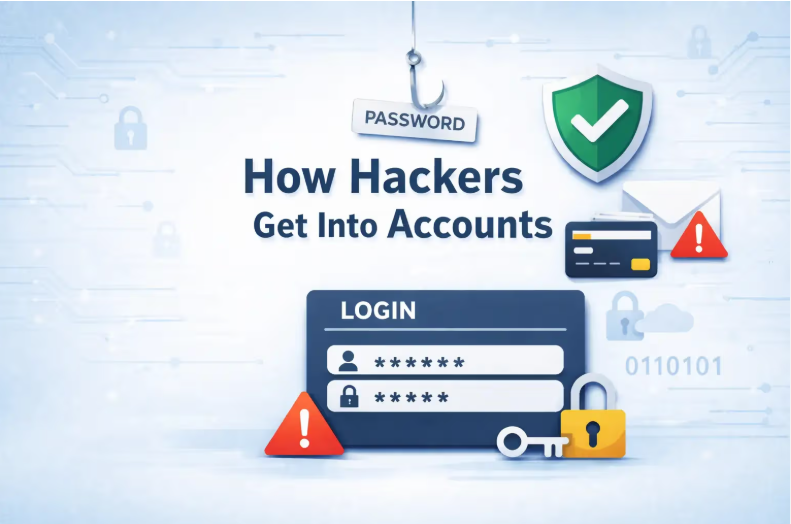
If you're dealing with the stress of a compromised account, you're not alone. This is a common issue, and it often happens because attackers use highly automated tools rather than guessing passwords manually. Many beginners struggle due to outdated information, misunderstanding how modern account systems are targeted, or relying on the false assumption that a complex password is all they need.
In this guide, you'll learn:
- what "how do hackers hack accounts" actually looks like in practice
- why these methods succeed so frequently
- what current industry guidance says about account takeovers
- practical ways to recognize attack attempts
- common mistakes to avoid when securing your digital profiles
Quick Answer
Understanding how do hackers hack accounts comes down to realizing they rarely guess your password. Instead, they use stolen data from previous breaches, trick you into handing over your credentials via fake login pages, or install malware to capture your keystrokes. Securing your accounts requires shifting from just passwords to multi-factor authentication.
Evidence Snapshot
| Topic | Current Evidence |
|---|---|
| Credential stuffing volume | Security reports indicate billions of stolen credentials are tested daily |
| Phishing success rates | Industry data shows phishing remains the leading initial access vector |
| MFA bypass attempts | Observational findings show a rise in attackers using phishing kits to steal 2FA codes |
| Malware keyloggers | Threat intelligence indicates a steady decline due to modern OS security, but still prevalent |
| Account takeover financial impact | Studies show average losses per corporate account compromise exceed $12,000 |
What Is "How Do Hackers Hack Accounts"?
When we ask how hackers hack accounts, we are looking at the mechanics of Account Takeover (ATO). It is the process of gaining unauthorized access to an online profile, such as email, banking, or social media.
At its core, account hacking works by bypassing the authentication process. This could mean acquiring the correct password, stealing an active session cookie so the website thinks the hacker is already logged in, or tricking the system into resetting the password to one the attacker controls.
Beginners often picture a hacker sitting at a terminal manually typing passwords. In reality, the process is heavily automated and relies on exploiting human psychology or poor data security by other websites. Understanding who is behind these operations helps clarify their motives; you can read more about the different types of hackers to see how criminal syndicates differ from opportunistic individuals.
Current Research or Industry Status
Security experts currently have a strong understanding of the account takeover lifecycle. Established facts show that the vast majority of account hacks do not involve breaking the target website's security. Instead, they exploit the user's reused passwords or trick the user directly.
However, significant uncertainties remain regarding the scale of AI-assisted attacks. Current developments in 2026 suggest threat actors are using large language models to generate highly convincing, personalized phishing emails at scale. Despite these advancements, current evidence suggests the fundamental methods of stealing accounts remain largely unchanged from previous years.
Why This Happens
Understanding why account hacking works requires looking at the root causes that give attackers an advantage.
Wrong assumptions
People assume their accounts are not valuable enough to target. In reality, automated bots do not care about your individual worth; they test millions of accounts simultaneously looking for any that work.
Outdated information
Many still believe that as long as their password has special characters and numbers, it is safe. This ignores the fact that if that exact password was exposed in a breach on another site, the complexity no longer matters.
Technical limitations
Websites often have limits on how many times a password can be guessed, but attackers bypass this by using massive networks of proxy servers to distribute their guesses, making blockades ineffective.
Environmental factors
The sheer volume of data breaches over the last decade means billions of real usernames and passwords are publicly available on the dark web, providing attackers with the exact keys to your accounts.
Why It Matters
Understanding the specific methods used to hack accounts is crucial because you cannot defend against a threat you do not comprehend.
The consequences of an account takeover extend far beyond a minor inconvenience. If your primary email is hacked, an attacker can reset the passwords to every other account linked to that email—banking, social media, cryptocurrency wallets.
Beginners often get confused by security advice because they don't understand the attack vectors. They might change their password after a breach but leave themselves exposed because they don't realize the attacker already has their active login session. Misinformation spreads easily because people blame the website's security rather than their own password hygiene.
How to Solve or Understand the Topic
To grasp how hackers hack accounts, you need to look at the most common techniques they actually deploy today.
Step 1: Credential Stuffing
This is currently the most common method. Attackers take massive lists of usernames and passwords leaked from one website and use automated software to test them on other websites. It works entirely because people reuse passwords across their banking, email, and social media.
Step 2: Phishing and Deception
Instead of hacking the system, the hacker hacks the user. They send an email pretending to be your bank or a service you use, claiming your account is locked. The email contains a link to a fake login page designed to look identical to the real one. When you type your credentials in, the hacker captures them.
Step 3: Malware and Session Theft
If an attacker can get you to download a malicious file or visit a compromised website, they can install malware on your device. Modern malware often targets "session cookies"—small files that keep you logged in. By stealing the cookie, the hacker can bypass the login screen entirely, rendering your password useless.
Step 4: Password Spraying
Instead of guessing many passwords for one account (which gets locked out), attackers guess one common password (like "Password123!") across millions of different accounts. This avoids triggering account lockouts while still finding the handful of users who use that weak password.
Common Mistakes
Mistake: Reusing passwords across different services
Why it happens: Human brains are not designed to memorize dozens of random, complex strings. People prioritize convenience. How to avoid it: Use a reputable password manager. It generates and remembers unique passwords for every account, so a breach on one site does not compromise your others.
Mistake: Clicking links in security alert emails
Why it happens: Attackers create a false sense of urgency, making you panic and click without thinking. How to avoid it: Never click a link in an email claiming your account is at risk. Navigate to the website directly by typing the URL into your browser or using your official app.
Mistake: Ignoring data breach notifications
Why it happens: People think "It's just a forum I forgot about, it doesn't matter." How to avoid it: Assume any breach matters. If you used the same password or a similar password anywhere else, change it immediately on those critical accounts.
Mistake: Approving unexpected Multi-Factor Authentication (MFA) prompts
Why it happens: MFA fatigue. When a user gets spammed with login prompts, they eventually hit "approve" just to make the notifications stop. How to avoid it: Never approve an MFA prompt you didn't initiate. If you are receiving unexpected prompts, it means someone already has your password and is trying to log in. Change your password immediately.
Factors That Affect Results
Several variables determine whether an account hacking attempt succeeds:
- Password uniqueness: Whether the password is used on multiple sites.
- MFA implementation: Whether the account requires a second factor, and what type (SMS is weaker than hardware keys).
- User awareness: The ability to identify a fake login page or suspicious email.
- Device security: Whether the device used to log in is free of malware or spyware.
- Session management: Whether active sessions are properly terminated when logging out or changing devices.
Comparison Table
Understanding the different methods highlights why a single defense strategy fails.
| Attack Method | Advantages for Attacker | Limitations |
|---|---|---|
| Credential Stuffing | Highly automated; high success rate on reused passwords | Completely useless if the user has unique passwords |
| Phishing | Bypasses all technical security by tricking the human directly | Relies on the user clicking a link and failing to spot fakes |
| Session Cookie Theft | Bypasses passwords and MFA entirely | Requires the user to be infected with malware first |
| Password Spraying | Evades account lockout mechanisms | Very low success rate per campaign; relies on poor base passwords |
What Current Evidence Suggests
| Topic | Evidence Strength |
|---|---|
| Password reuse enabling breaches | Strong (Decades of data confirm this is the primary vector) |
| Hardware keys stopping account takeovers | Strong (YubiKey/WebAuthn data shows near-zero successful phishing against them) |
| SMS-based MFA being secure | Weak (SIM swapping and SS7 protocol exploits easily bypass SMS codes) |
| Antivirus stopping session theft | Moderate (Modern endpoint detection is better, but advanced malware still evades it) |
| Complex passwords preventing hacks | Weak (Complexity matters less than uniqueness in the age of stuffing) |
Pro Tips
- Monitor your exposure: You cannot stop a website from being breached, but you can find out if your data was in the leak. Using a platform like DarkStats lets you check if your credentials are circulating in illicit spaces, allowing you to change passwords before attackers use them in credential stuffing campaigns.
- Understand phishing mechanics: Attackers are incredibly good at mimicking login portals. Reading a detailed dark web phishing guide helps you recognize the subtle differences between a real site and a fake one designed to steal your account.
- Upgrade your MFA: If possible, move away from SMS text messages for two-factor authentication. Use an authenticator app on your phone, or better yet, a physical hardware security key (like a YubiKey) which physically prevents phishing attacks from succeeding.
Safety / Best Practices
Follow reliable guidance from established cybersecurity organizations. Verify information before sharing your login details with any third-party service. Use trusted resources to check your breach status, and understand the limitations of your security tools. No single action can guarantee 100% account safety. Avoid unsupported claims from services promising to "remove your data from the dark web," as once data is leaked, it cannot be erased. Focus instead on making the leaked data useless by changing your passwords.
Related Guides
- What Is Hacking? Types, Attacks & Safety Guide
- Types of Hackers: White Hat vs Black Hat vs Gray Hat
- How to Recognize and Avoid Phishing Scams
- Setting Up a Secure Password Manager
FAQ
How do hackers get my password in the first place? Hackers usually get your password from large-scale data breaches. When a website is compromised, its database of usernames and passwords is often sold on the dark web. If you reused that password on another site, hackers will use automated tools to test it there.
Can hackers hack my account without my password? Yes. Through session hijacking, hackers can steal the digital "key" (session cookie) that keeps you logged into a website. If they steal this cookie, the website thinks the hacker is you, granting access without requiring a password or two-factor code.
What is credential stuffing? Credential stuffing is an automated attack where hackers take lists of stolen username and password pairs from a breached website and use software to test them on hundreds of other websites. It relies entirely on the common habit of reusing the same password everywhere.
Does two-factor authentication (2FA) stop account hackers? 2FA significantly reduces the risk, but it is not foolproof. While it stops basic credential stuffing, attackers can bypass 2FA through "MFA fatigue" (spamming you with approval prompts until you approve one) or by intercepting SMS codes through SIM swapping.
How do I know if my account has been hacked? Common signs include receiving password reset emails you didn't request, being logged out of your session unexpectedly, seeing logins from unfamiliar locations in your account's security log, or friends reporting receiving spam messages from your profile.
Can someone hack my email with just my email address? Your email address alone is not enough for someone to hack your account. They still need your password or a way to bypass the login screen. However, knowing your email address allows them to target you specifically with phishing emails or password spray attacks.
Why do hackers want my social media accounts? Social media accounts are highly valuable. Hackers use them to run scam advertisements, spread malware to your followers, or impersonate you to trick your friends and family into sending money. They can also be sold on underground markets.
Key Takeaways
- Main takeaway: Hackers hack accounts primarily by exploiting stolen passwords from other breaches and tricking users into giving up their credentials, not by breaking into the website's servers.
- Important limitation: Even strong passwords are useless if they are reused on multiple sites.
- Most common mistake: Approving unexpected multi-factor authentication prompts out of frustration or habit.
- Best practice: Use a password manager for unique passwords and switch to app-based or hardware-based MFA.
- Current evidence: Credential stuffing and phishing remain the dominant forces behind account takeovers in 2026.
- Next step: Check if your email or passwords have appeared in recent data breaches.
Conclusion
Understanding how hackers hack accounts reveals that the weakest link is rarely the technology itself, but rather how we manage our credentials. By shifting away from password reuse and adopting multi-factor authentication, you neutralize the most common attack vectors. Staying safe online doesn't require advanced technical skills; it requires building consistent habits that make automated attacks ineffective. To better understand the motivations behind these attacks, continue reading our breakdown on the different types of hackers and how they operate.