



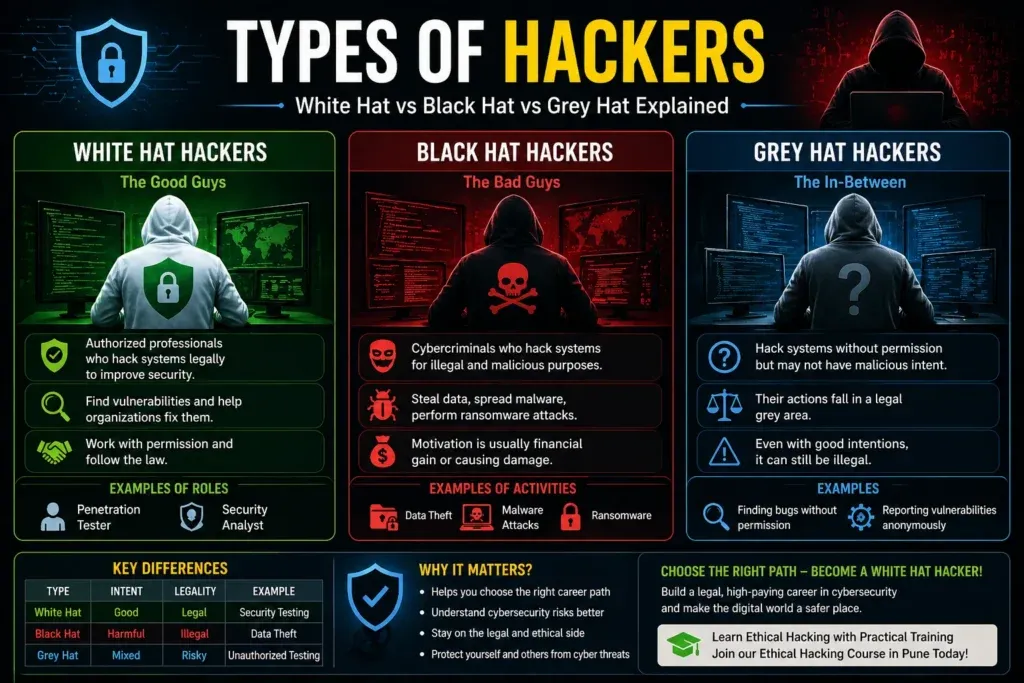
If you're dealing with confusion about hacker stereotypes, you're not alone. This is a common issue, and it often happens because movies and news outlets paint all hackers as cybercriminals. Many beginners struggle due to outdated information, misunderstanding how the cybersecurity industry actually functions, or relying on sensationalized media portrayals.
In this guide, you'll learn:
- what the different types of hackers are
- why these distinct categories exist
- what current industry guidance says about their legality
- practical ways to understand their motivations
- common mistakes to avoid when judging hacker activities
Quick Answer
Understanding the different types of hackers comes down to intent and authorization. White hat hackers are ethical professionals hired to find flaws legally. Black hat hackers are cybercriminals who exploit systems for financial gain or malice. Gray hat hackers operate without permission but typically lack malicious intent, often exposing flaws to force companies to fix them.
Evidence Snapshot
| Topic | Current Evidence |
|---|---|
| White hat demand | Industry reports (ISC2) show a global cybersecurity workforce gap of millions |
| Black hat impact | Financial institution data indicates billions lost annually to black hat operations |
| Gray hat legality | Legal case logs show increasing prosecution of unauthorized access, regardless of intent |
| Bug bounty growth | Platform data indicates a steady rise in companies paying for ethical hacking |
| Attribution difficulty | Cybersecurity studies indicate accurately identifying hacker types post-breach remains challenging |
What Are the Different Types of Hackers?
When we discuss the types of hackers, we are categorizing people who possess the exact same technical skills but use them for entirely different purposes. The "hat" metaphor is the industry standard way to separate them.
A hacker is simply someone who finds vulnerabilities in computer systems. The label applied to them depends entirely on two factors: whether they had permission to access the system, and what they planned to do with the information.
Beginners often assume the term only applies to criminals. In reality, the cybersecurity industry relies heavily on hackers to test defenses. From corporate security teams to independent researchers, people who identify as hackers are the primary force keeping modern digital infrastructure secure.
Current Research or Industry Status
Security experts and legal systems currently have a clear, established consensus on white hat and black hat activities. White hat hacking is legally protected when governed by a strict contract, while black hat hacking is universally prosecuted as a crime.
However, significant gray areas remain regarding gray hat hackers. Emerging legal precedents suggest that courts are becoming less tolerant of the "but I was trying to help" defense. Current developments in 2026 show companies increasingly directing independent researchers toward official bug bounty programs rather than tolerating unsolicited system probing.
Why This Happens
Understanding why these distinctions exist requires looking at the root causes of system vulnerabilities.
Wrong assumptions
People assume that if someone can break into a system, they must be doing something illegal. This ignores the fact that you cannot build a secure house without knowing how a burglar might break in.
Outdated information
Old media heavily popularized the "lone cybercriminal" trope in the 1990s. This stereotype persists today, overshadowing the massive, legitimate ethical hacking industry.
Technical limitations
Software is inherently flawed. Because developers cannot predict every way their code might be manipulated, they must hire specialists to attack it proactively.
Environmental factors
The massive underground economy for stolen data financially incentivizes black hat activities, creating a constant arms race that requires more white hat defenders.
Why It Matters
Understanding these distinctions is crucial for anyone interacting with digital systems, whether you are a business owner, a job seeker, or a casual user.
The consequences of misunderstanding these labels can be severe. A business might mistake a legitimate security audit for an attack, or an aspiring professional might accidentally commit a felony by crossing the line from white hat to gray hat research.
Beginners often get confused by headlines that just say "hacker breached a system" without specifying the type. This fuels unnecessary panic and spreads misinformation about whether a company's data was actually stolen or safely secured by its own team.
How to Solve or Understand the Topic
To grasp the hacker spectrum, you need to look past the technical actions and focus on the context.
Step 1: Look at authorization
The legal boundary between a white hat and a gray hat is a signed piece of paper. If a hacker has explicit, documented permission to test a system, they are operating ethically. If they do not, they are breaking the law, regardless of their intentions.
Step 2: Evaluate the intent
Once inside a system, what does the hacker do? Do they document the flaw, report it quietly, and help fix it? Or do they copy the database and demand a ransom? Intent separates a security professional from a criminal.
Step 3: Understand the shared mechanics
It is important to realize that the technical process of finding a vulnerability is identical across all three types. The methods used to bypass security do not change based on the hacker's morality. To see exactly how these technical processes overlap regardless of the hat color, you can read more about how does hacking work in our dedicated breakdown.
Common Mistakes
Mistake: Believing gray hats are just misunderstood heroes
Why it happens: They expose real flaws that companies ignore, which feels like a public service. How to avoid it: Recognize that unauthorized access is illegal. Entering a system without permission violates computer fraud laws, even if the data is never stolen.
Mistake: Assuming white hats can't make mistakes
Why it happens: Ethical hackers are viewed as security experts who always do things by the book. How to avoid it: Understand that ethical hackers can accidentally cause system outages during a test, which is why strict rules of engagement and scope limits are required in their contracts.
Mistake: Thinking black hats always get caught
Why it happens: Movies and news stories focus on the hackers who are apprehended. How to avoid it: Realize that attribution in cybersecurity is incredibly difficult. Many black hat operators use heavy anonymization and rely on jurisdictions that do not extradite cybercriminals.
Mistake: Confusing "script kiddies" with actual black hats
Why it happens: The public lumps all malicious actors into the "master hacker" category. How to avoid it: Understand that many black hat attacks are executed by low-skill individuals using pre-written malicious software bought on the dark web, rather than custom-coded exploits.
Factors That Affect Results
How a hacker is classified and treated depends on several variables:
- Documentation: Having a signed Statement of Work (SOW) before a test begins.
- Scope adherence: Staying only within the agreed-upon IP addresses or applications.
- Disclosure methods: Reporting a flaw privately to the company versus posting it publicly on social media.
- Jurisdiction: Cyber laws vary wildly by country; an action legal in one nation might be a serious crime in another.
- Data handling: Whether the hacker actually exfiltrates (copies) sensitive data or simply proves access is possible.
Comparison Table
| Hacker Type | Goal | Legality | Typical Target | Outcome |
|---|---|---|---|---|
| White Hat | Improve security | Legal (Authorized) | Employers or clients | Vulnerability report and patch |
| Black Hat | Financial gain, theft, disruption | Illegal (Unauthorized) | Any vulnerable system | Data breach, ransomware, fraud |
| Gray Hat | Curiosity, proving a point | Illegal (Unauthorized) | Systems of interest | Public vulnerability disclosure |
What Current Evidence Suggests
| Topic | Evidence Strength |
|---|---|
| White hats reducing breach impact | Strong (Consistent data showing proactive testing prevents breaches) |
| Black hats targeting small businesses | Strong (Insurance and breach reports confirm high targeting rates) |
| Gray hats acting as a bridge | Weak (Legal risks are pushing them toward official white hat channels) |
| "Hacker" as a neutral term in tech | Strong (Industry universally uses the term without malice) |
| Public forgiving gray hat actions | Weak (Courts increasingly prosecute unauthorized access strictly) |
Pro Tips
- Verify credentials: If you are hiring someone to test your systems, look for recognized certifications like OSCP or CEH. These indicate the individual has been trained in white hat methodologies and legal boundaries.
- Understand Bug Bounties: Many gray hat operators transition to white hat by using bug bounty platforms. These platforms provide a legal framework where researchers are paid for finding flaws, bridging the gap between independent research and authorized testing.
- Watch the disclosure: A true white hat will never publicly disclose your vulnerability without giving you time to fix it. Public shaming is a tactic associated with gray or black hat actors.
Safety / Best Practices
Follow reliable guidance when navigating the cybersecurity industry. Verify the credentials and legal standing of anyone offering penetration testing services. Use trusted platforms for freelance security testing to ensure proper legal contracts are in place. Understand the limitations of your own knowledge before attempting to test systems yourself. Avoid unsupported claims from individuals offering "hack back" services, as actively attacking another network is illegal in most jurisdictions, even if they attacked you first.
Related Guides
- What Is Hacking? Types, Attacks & Safety Guide
- How Does Hacking Work? A Beginner's Guide to Modern Cyber Attacks
- How to Start a Career in Ethical Hacking
- Understanding Bug Bounty Programs
FAQ
What is a white hat hacker? A white hat hacker is an ethical cybersecurity professional. They are hired by organizations to break into their own systems legally. Their goal is to find security flaws before malicious actors do, document them, and help the organization fix the vulnerabilities.
What is a black hat hacker? A black hat hacker is a cybercriminal. They break into computer systems without authorization to steal data, deploy ransomware, or cause disruption. Their actions are illegal and are driven by financial gain, espionage, or malice.
What is a gray hat hacker? A gray hat hacker operates without malicious intent but also without legal permission. They might scan a company's network, find a flaw, and report it to the company, sometimes asking for a fee. While their intentions may be good, their methods are illegal because they lacked authorization.
Can a white hat hacker go to jail? Yes, if they step outside the boundaries of their authorized contract. If a white hat hacker tests a system they were not explicitly hired to test, or if they cause unintended damage that violates their agreement, they can face legal consequences.
Do gray hat hackers get paid? Sometimes, but not through official channels. They may request a finder's fee from the company they hacked, or they may receive donations from the community. However, relying on this is unreliable, and demanding payment for returning stolen data can cross the line into extortion.
Which type of hacker makes the most money? Legally, highly experienced white hat hackers make the most money. Senior penetration testers, security architects, and chief information security officers (CISOs) earn significant salaries. While black hat hackers can make large sums from single ransomware attacks, their income is unpredictable and comes with the risk of imprisonment.
Are all hackers technically skilled? No. In the black hat community, many attackers are "script kiddies." These individuals lack deep technical understanding and simply run pre-written malicious tools created by more skilled developers. True expertise is required across all hat types to find novel, previously unknown vulnerabilities.
Why do companies hire white hat hackers? Because it is impossible to build a completely secure system. Developers are often too close to their own code to see its flaws. White hat hackers provide an objective, adversarial perspective, attacking the system exactly as a criminal would, but in a safe, controlled environment.
Key Takeaways
- Main takeaway: The types of hackers are defined purely by authorization and intent, not by their technical skills.
- Important limitation: The line between white and gray hat is entirely dependent on legal documentation, which can sometimes be ambiguous.
- Most common mistake: Assuming all hackers are criminals due to media misrepresentation.
- Best practice: If you need security testing, always use formal contracts and verified professionals.
- Current evidence: The industry is actively pushing gray hat researchers into legal white hat channels via bug bounty programs.
- Next step: Learn the technical methods these different hackers use to breach systems.
Conclusion
Categorizing hackers by hat color is the most effective way to understand the modern cybersecurity landscape. It separates the criminals from the defenders, while highlighting the risky middle ground occupied by unauthorized researchers. By focusing on the context of authorization rather than just the technical act of hacking, you can better navigate industry news, make informed decisions about digital security, and understand the motivations driving the people behind the screen. To dive deeper into the technical mechanics these different groups use, continue reading our guide on how does hacking work.