


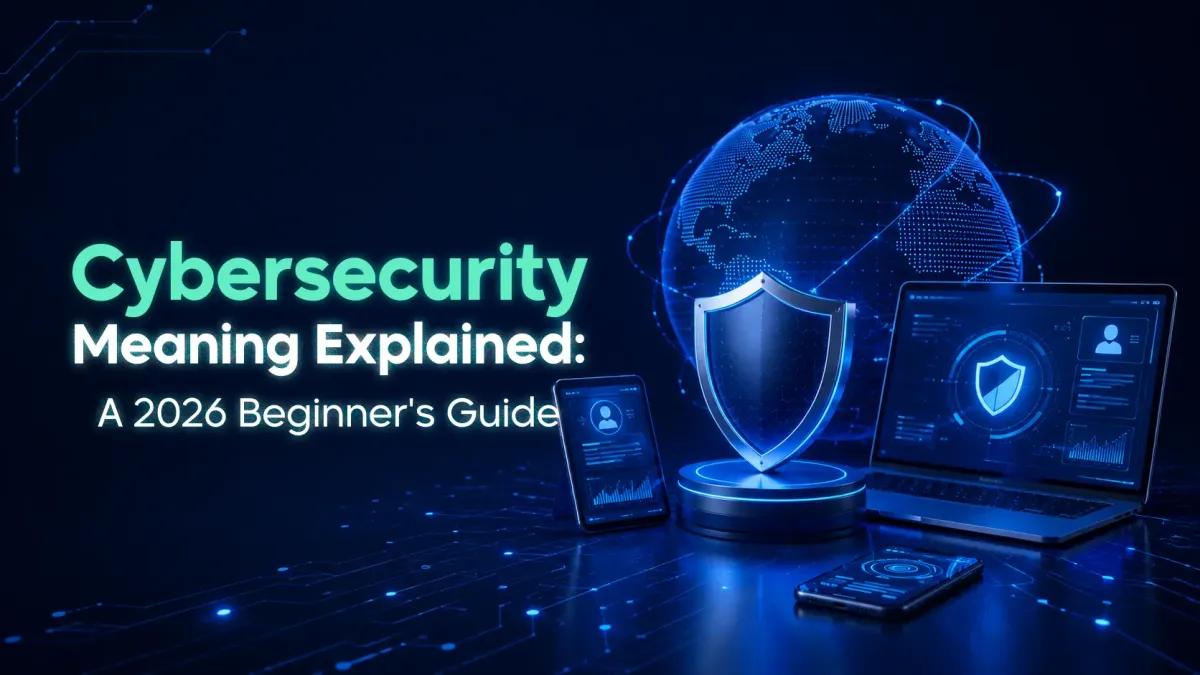
Understanding what is cybersecurity can feel overwhelming because the tech industry surrounds the topic with heavy jargon and complex acronyms. This makes the field seem completely inaccessible to beginners who just want to understand how digital protection works. In reality, cybersecurity is a logical, structured practice of defending data and systems from digital attacks, and anyone can grasp its foundations. In this guide, you will learn exactly how information security operates, the specific roles professionals handle, and how to start building your skills from scratch today without feeling lost.
QUICK ANSWER
Cybersecurity is the practice of protecting computers, networks, and data from digital attacks. It works by using specialized tools, policies, and processes to prevent unauthorized access. To understand it simply, it is the digital equivalent of locking the doors and setting up an alarm system for a building.
WHAT IS CYBERSECURITY?
Cyber security explained in its simplest form is the defense of internet-connected systems. This includes hardware, software, and the data stored on them. When you ask "what is cyber security," you are really asking how digital assets are kept safe from thieves, hackers, and accidental damage.
The field relies on a combination of technology, processes, and people. Firewalls and encryption handle the technology side. Incident response plans handle the processes. Security analysts and engineers handle the human element, actively monitoring for threats and fixing vulnerabilities before attackers can exploit them.
At the core of all cybersecurity practices is the CIA Triad: maintaining the Confidentiality (keeping data secret), Integrity (preventing data from being altered), and Availability (ensuring data is accessible when needed).
[Image Placeholder: CIA Triad Infographic showing a three-point triangle connecting Confidentiality, Integrity, and Availability with brief visual examples for each.]
People use these practices because modern life is entirely dependent on digital infrastructure. From banking to healthcare, every industry needs to ensure their systems remain functional and confidential.
WHY IS CYBERSECURITY IMPORTANT?
Understanding why is cybersecurity important requires looking at the sheer scale of modern digital threats. It is not just a technical issue; it is a massive global economic and human issue.
To understand the scope, consider the data:
- Global Costs: Cybercrime is projected to cost the global economy $10.5 trillion annually by 2025, according to Cybersecurity Ventures. This makes it the third-largest economy in the world, behind only the US and China.
- Data Breaches: Millions of records are breached every year. The average cost of a single corporate data breach reached $4.88 million in 2024 (IBM Cost of a Data Breach Report).
- Workforce Shortage: There is a massive global workforce shortage of nearly 4 million cybersecurity professionals (ISC2 2024 Workforce Study). This means there are far more open jobs than qualified people to fill them.
Data Protection & Privacy: Organizations collect massive amounts of sensitive data. Cybersecurity prevents this data from being stolen and ensures individuals have a right to keep their medical records and financial information private.
Businesses & Governments: A single successful cyberattack can bankrupt a company through fines and lost trust. For governments, national security relies on secure networks to protect state secrets and critical infrastructure like power grids from hostile nations.
HOW DOES CYBERSECURITY WORK?
Cybersecurity does not rely on a single magic tool. It works through a continuous cycle of four distinct phases, often modeled after industry frameworks like the NIST Cybersecurity Framework.
[Image Placeholder: Cybersecurity Lifecycle Diagram showing a continuous circular loop connecting Prevention, Detection, Response, and Recovery.]
Prevention: This is the first line of defense. It involves deploying firewalls, enforcing strong password policies, encrypting data, and training employees not to click malicious links. The goal is to make it as hard as possible for an attacker to get in.
Detection: No defense is perfect. Detection systems monitor networks and computers for suspicious activity. If an attacker bypasses the prevention phase, tools like Intrusion Detection Systems (IDS) alert the security team that something is wrong.
Response: When a threat is detected, the response phase kicks in. Security professionals isolate compromised computers, block malicious IP addresses, and begin investigating how the breach occurred.
Recovery: After a threat is neutralized, systems must be restored. This involves pulling data from secure backups, patching the vulnerability that allowed the attack, and returning the business to normal operations.
TYPES OF CYBERSECURITY
The cybersecurity career path is broad because digital infrastructure is complex. Different specialties focus on protecting different parts of the network.
[Image Placeholder: Cybersecurity Domains Chart illustrating a Venn diagram showing how Network, Cloud, Endpoint, and Application security overlap in the center to protect Data.]
Network Security
- What it is: Protecting the infrastructure that connects computers and devices. [Internal Link: Network Security Explained]
- Why it matters: If the network is compromised, every device attached to it is at risk.
- Who uses it: Enterprise IT departments, cloud providers.
- Strengths: Stops attackers from moving laterally through a company's systems.
- Limitations: Can be complex to manage in large, hybrid cloud environments.
- Beginner suitability: High. It is a foundational skill every beginner should learn first.
Cloud Security
- What it is: Protecting data, applications, and services hosted in cloud environments like AWS or Azure. [Internal Link: Cloud Security Explained]
- Why it matters: Almost all modern businesses use the cloud, and misconfigured cloud storage is a leading cause of data breaches.
- Who uses it: Cloud architects, DevSecOps teams.
- Strengths: Highly scalable and automated.
- Limitations: Requires understanding of complex shared-responsibility models.
- Beginner suitability: Moderate. Learn basic networking and Linux first.
| Feature | Network Security | Cloud Security |
|---|---|---|
| Focus | On-premise routers, switches, firewalls | Virtual networks, cloud storage, SaaS apps |
| Perimeter | Fixed physical boundaries | Fluid, software-defined boundaries |
| Primary Threat | Unauthorized network access, DDoS | Misconfigurations, insecure APIs |
| Best For | Traditional enterprise environments | Modern, remote, and hybrid workforces |
Endpoint Security
- What it is: Securing individual devices like laptops, phones, and servers.
- Why it matters: Endpoints are the easiest targets for phishing and malware.
- Who uses it: IT support, security operations centers (SOCs).
- Strengths: Stops threats directly at the user level before they reach the network.
- Limitations: Difficult to manage when employees use personal devices for work (BYOD).
- Beginner suitability: High. Easy to understand conceptually.
Application Security
- What it is: Finding and fixing security flaws in software applications.
- Why it matters: Hackers exploit bugs in code to steal data or take over servers.
- Who uses it: Software developers, QA testers.
- Strengths: Fixes vulnerabilities at the root cause.
- Limitations: Requires programming knowledge.
- Beginner suitability: Low for absolute beginners, but great for those with a coding background.
Information Security
- What it is: The broad management of data confidentiality, integrity, and availability.
- Why it matters: It provides the overarching policies for how data is handled, regardless of the technology used.
- Who uses it: Chief Information Security Officers (CISOs), compliance officers.
- Strengths: Ensures an entire organization follows legal and regulatory standards.
- Limitations: Can become heavily focused on paperwork and compliance rather than active defense.
- Beginner suitability: High conceptually, but operational roles require experience.
Mobile Security
- What it is: Protecting smartphones and tablets from malware, data leaks, and physical theft.
- Why it matters: People store their entire lives on their phones, including banking and personal photos.
- Who uses it: Mobile device management (MDM) administrators, consumers.
- Strengths: Prevents unauthorized app installations and data extraction.
- Limitations: Mobile operating systems limit how much security software can actually do in the background.
- Beginner suitability: Very high.
IoT Security
- What it is: Securing internet-connected "smart" devices like cameras, thermostats, and industrial sensors.
- Why it matters: IoT devices often have terrible built-in security and are easily hacked to create botnets.
- Who uses it: Smart home users, industrial control system engineers.
- Strengths: Prevents your smart devices from being used to attack other people.
- Limitations: Extremely difficult to patch or update once deployed.
- Beginner suitability: Moderate. Good for hobbyists.
Identity & Access Management (IAM)
- What it is: Ensuring only the right people have access to the right systems.
- Why it matters: Stolen credentials are the number one way attackers breach networks.
- Who uses it: System administrators, security engineers.
- Strengths: Limits the damage an attacker can do even if they steal a password.
- Limitations: Poor implementation can frustrate employees and slow down workflow.
- Beginner suitability: High. Understanding authentication is a core beginner concept.
COMMON CYBER THREATS
To defend systems, you have to know what you are defending them against.
[Image Placeholder: Attack Flowchart showing the progression from a Phishing email -> User clicks link -> Malware executes -> Data Exfiltration to Attacker.]
Malware: Malicious software (like viruses, worms, and trojans) designed to damage, disrupt, or gain unauthorized access to a system. [Internal Link: What Is Malware?]
Ransomware: A specific type of malware that encrypts a victim's files and demands a payment (usually in cryptocurrency) to unlock them. [Internal Link: What Is Ransomware?]
Phishing: Fraudulent emails or text messages designed to trick a person into revealing sensitive information, like passwords or credit card numbers. [Internal Link: What Is Phishing?]
Social Engineering: Manipulating people into breaking security procedures. A hacker might call an employee, pretend to be IT support, and ask for their login credentials.
DDoS (Distributed Denial of Service): Overwhelming a server or network with so much fake internet traffic that it crashes, preventing legitimate users from accessing the service.
Password attacks: Using automated tools to guess or crack passwords. This includes brute-force attacks (trying every combination) or dictionary attacks (trying common words).
Zero-day exploits: An attack that targets a software vulnerability that the software maker does not even know exists yet. There is no patch available, making these attacks highly dangerous and valuable.
WHAT DOES A CYBERSECURITY PROFESSIONAL DO?
Cyber security jobs are incredibly diverse. What a professional does depends entirely on their specific role within a security team.
SOC Analyst
- What it is: A Security Operations Center analyst acts as the first responder to cyber threats. [Internal Link: SOC Analyst Guide]
- Why it matters: They are the ones watching the radar. Without them, attacks would go unnoticed for months.
- Who uses it: Medium to large enterprise security teams.
- Strengths: Provides real-time threat monitoring and immediate action.
- Limitations: Can involve long hours and repetitive alert triage.
- Beginner suitability: Very high. This is the most common entry-level job.
Security Analyst
- What it is: A broader role focused on assessing an organization's security posture and implementing protective measures. [Internal Link: Security Analyst Career Guide]
- Why it matters: They connect the dots between network vulnerabilities and business risk.
- Who uses it: Consultancies, internal IT security teams.
- Strengths: Offers a wide variety of work, from policy writing to technical configuration.
- Limitations: Can require juggling many different projects at once.
- Beginner suitability: High. A natural step up from a SOC analyst.
| Feature | SOC Analyst | Security Analyst |
|---|---|---|
| Primary Focus | Real-time alert monitoring and triage | Broad security posture and risk assessment |
| Environment | Shift work in a Security Operations Center | Standard business hours, project-based |
| Goal | Identify and isolate active threats | Improve overall security architecture |
| Best For | Detail-oriented people who thrive under pressure | Big-picture thinkers who like variety |
Pen Tester (Penetration Tester)
- What it is: An ethical hacker paid to break into a company's systems legally to find vulnerabilities before real criminals do. [Internal Link: Ethical Hacking Guide]
- Why it matters: It provides the most accurate picture of an organization's actual security flaws.
- Who uses it: Specialized security firms, large corporations.
- Strengths: Highly engaging work that requires deep technical skill and creative thinking.
- Limitations: High stress, requires constant learning to stay ahead of attackers.
- Beginner suitability: Low. Requires a solid foundation in networking and coding first.
Incident Responder
- What it is: The digital firefighter. When a major breach occurs, they lead the investigation to contain the threat and identify the attacker.
- Why it matters: They minimize the financial and reputational damage of a successful cyberattack.
- Who uses it: Dedicated incident response firms, enterprise SOCs.
- Strengths: High-impact work that directly saves companies from disaster.
- Limitations: Extremely high pressure; you are usually called in when things are already going very wrong.
- Beginner suitability: Low. Usually requires years of experience as a SOC analyst.
Security Engineer
- What it is: The architect and builder of security infrastructure. They design, build, and maintain firewalls, intrusion detection systems, and secure cloud environments.
- Why it matters: They create the technical barriers that keep attackers out.
- Who uses it: Tech companies, cloud providers.
- Strengths: Highly technical, deeply respected, and well-compensated.
- Limitations: Can be heavily focused on infrastructure rather than threat hunting.
- Beginner suitability: Low to Moderate. Often requires a background in IT or system administration.
CYBERSECURITY JOBS
Entering the cybersecurity career path requires understanding the progression of roles. You rarely start as a penetration tester.
[Image Placeholder: Cybersecurity Career Roadmap Graphic showing a timeline/pathway from IT Help Desk -> Tier 1 SOC -> Tier 2/3 SOC -> Security Engineer/IR -> CISO.]
Entry-level roles: Most beginners start as SOC Analysts (Tier 1), IT Help Desk technicians with a security focus, or Junior Security Analysts. In these roles, you monitor alerts, review logs, and learn how enterprise networks operate.
Career roadmap: A standard path looks like this:
- Tier 1 SOC Analyst: Monitoring and triaging basic alerts (0-2 years).
- Tier 2/3 SOC Analyst: Investigating complex incidents and threat hunting (2-4 years).
- Security Engineer or Incident Responder: Building security tools or leading breach investigations (4-7 years).
- Security Architect or CISO: Designing top-level security strategies for entire organizations (8+ years).
Skills needed: Regardless of the specific job title, all cyber security jobs require analytical thinking, a basic understanding of how computers communicate (networking), and a meticulous attention to detail.
CYBERSECURITY SALARY
Compensation in this field is generally high due to the massive demand for skilled workers and the critical nature of the work. Here is a look at average cyber security salary ranges for a mid-level professional (roughly 3-5 years of experience) in 2026. [Internal Link: Cybersecurity Salary Guide]
United States Salaries
| Role | Average Annual Salary (USD) |
|---|---|
| SOC Analyst | $85,000 - $105,000 |
| Security Analyst | $95,000 - $120,000 |
| Penetration Tester | $110,000 - $140,000 |
| Security Engineer | $120,000 - $155,000 |
| Incident Responder | $105,000 - $135,000 |
Europe Salaries
| Role | Average Annual Salary (EUR/GBP Equivalent) |
|---|---|
| SOC Analyst | €50,000 - €65,000 |
| Security Analyst | €60,000 - €80,000 |
| Penetration Tester | €65,000 - €90,000 |
| Security Engineer | €75,000 - €100,000 |
| Incident Responder | €65,000 - €85,000 |
Remote Jobs
Remote work is highly prevalent in cybersecurity. Remote salaries often align with US averages if you work for an American company, regardless of where you live. Freelance penetration testing and bug bounty hunting are also popular remote options, where income is entirely project-based and can range from a few hundred to tens of thousands of dollars per engagement.
DO YOU NEED A DEGREE?
The short answer is no. While a cyber security degree (like a Bachelor of Science in Computer Science or Cybersecurity) can help you get past initial HR filters, it is no longer strictly necessary. [Internal Link: Cybersecurity Certifications]
| Pathway | Time Commitment | Cost | Best For |
|---|---|---|---|
| Degree | 4 years | $40k - $100k+ | Traditional students, government contractors |
| Bootcamp | 3 - 6 months | $5k - $15k | Career switchers needing fast, structured learning |
| Self-Learning | 6 - 12+ months | Free - $1k | Self-disciplined learners wanting to prove practical passion |
| Certifications | 2 - 6 months per cert | $300 - $1,500 | Anyone looking to prove specific, measurable skills to employers |
Degree: Provides a well-rounded theoretical foundation. Best for those who want a traditional university experience and plan to work in highly regulated environments (like government defense contracting).
Bootcamp: Intensive programs focused purely on practical skills. Good for career switchers who already have a degree in another field and need technical skills quickly.
Self-learning: Entirely possible using free internet resources, books, and home labs. This requires intense self-discipline but proves to employers that you have genuine practical ability.
Certifications: For most beginners, certifications carry more weight than degrees because they prove you have passed a standardized test on specific, practical security concepts.
BEST CYBERSECURITY CERTIFICATIONS
Certifications are the currency of the cybersecurity industry. They prove you have specific knowledge.
| Certification | Difficulty Level | Experience Required | Best Use Case |
|---|---|---|---|
| CompTIA Security+ | Beginner | None | Proving foundational knowledge for entry-level jobs |
| CompTIA Network+ | Beginner | None | Learning networking basics before Security+ |
| CEH | Intermediate | None (Official training recommended) | Learning hacker terminology and basic offensive tools |
| CompTIA CySA+ | Intermediate | None (Security+ recommended) | Proving defensive SOC skills and threat detection |
| CISSP | Advanced | 5 years paid experience | Moving into senior management, architecture, or CISO roles |
| Google Cybersecurity | Beginner | None | Absolute beginners needing a structured, low-cost starting point |
- CompTIA Security+: The absolute best starting point. It covers foundational concepts like risk management, cryptography, and network threats. Most entry-level jobs list this as a requirement.
- CompTIA Network+: Usually taken before Security+. It teaches you how data moves across networks, which is a prerequisite for understanding how to defend them.
- Certified Ethical Hacker (CEH): Introduces you to the tools and techniques used by hackers. It is a good stepping stone toward penetration testing, though it is less respected by strict technical hiring managers than hands-on labs.
- Certified Information Systems Security Professional (CISSP): A management-level certification. You need five years of experience to even take the exam. It is the gold standard for moving into senior leadership roles.
- CompTIA CySA+: Focuses on defensive operations, threat detection, and incident response. An excellent follow-up to Security+ for aspiring SOC analysts.
- Google Cybersecurity Certificate: A relatively new, beginner-friendly option hosted on Coursera. Great for absolute beginners with zero technical background who need a structured starting point.
ESSENTIAL CYBERSECURITY SKILLS
To succeed, you need a mix of technical abilities and problem-solving mindsets.
Technical Skills:
- Networking: Understanding TCP/IP, DNS, HTTP, and how firewalls route traffic. This is non-negotiable.
- Linux: Most servers and security tools run on Linux. You must be comfortable navigating the command line.
- Cloud: Understanding basic AWS or Azure architecture, as most modern infrastructure lives in the cloud.
- Programming: You do not need to be a software developer, but knowing Python (for automation and scripting) and basic Bash is essential for efficiency.
Soft Skills:
- Communication: You will regularly have to explain complex technical risks to non-technical managers.
- Problem-solving: Threats change constantly. You must be able to think critically and adapt to situations you have never seen in a textbook.
HOW TO START LEARNING CYBERSECURITY
Cybersecurity for beginners can feel daunting, but the path is straightforward if you follow a logical progression.
Free resources: Start with YouTube channels like NetworkChuck or Professor Messer (for CompTIA content). Read free online guides and understand basic computer networking before you even touch security tools.
Labs: You cannot learn cybersecurity just by reading. Set up virtual machines on your own computer using VirtualBox. Build a small network (like a Kali Linux machine attacking a Windows machine) to practice safely in an isolated environment.
CTFs (Capture The Flag): These are gamified hacking challenges hosted on platforms like TryHackMe or HackTheBox. They present you with vulnerable machines that you have to "hack" to find a hidden text file (the flag). They are the single best way to build practical skills.
Practice platforms: TryHackMe is highly recommended for absolute beginners because it provides guided, step-by-step instruction. HackTheBox is better for intermediate users who want unguided challenges.
Roadmap:
- Learn basic networking and Linux command line (1-2 months).
- Complete a foundational certification like CompTIA Security+ (2-3 months).
- Do guided labs on TryHackMe focusing on defensive security (2-3 months).
- Build a home lab and practice incident response or basic scripting.
- Tailor your resume, build a portfolio of write-ups from your CTFs, and apply for Tier 1 SOC Analyst roles.
SAFETY & BEST PRACTICES
When learning cybersecurity, you must maintain strict ethical boundaries. Never test a system or scan a network without explicit, documented permission. Doing so is illegal, regardless of your intentions.
Professionals align their practices with established industry frameworks like the NIST Cybersecurity Framework (CSF) or ISO/IEC 27001. These frameworks provide the legal and ethical guidelines for how security should be managed. Stay within legal boundaries by using dedicated practice environments and always respecting user privacy.
FREQUENTLY ASKED QUESTIONS
What is cybersecurity in simple terms? It is the practice of protecting computers, networks, and digital data from theft, damage, or unauthorized access.
Is cybersecurity hard? It requires continuous learning and a solid understanding of technical concepts like networking and coding. It is not inherently "hard," but it requires dedication and analytical thinking.
Is cybersecurity a good career? Yes. It offers high salaries, excellent job security, and massive growth potential due to the global shortage of qualified professionals.
Can I learn cybersecurity for free? Yes. There are thousands of free YouTube tutorials, open-source textbooks, and free-tier practice platforms (like TryHackMe) that provide enough material to land an entry-level job.
What degree is best for cybersecurity? A degree in Computer Science, Information Technology, or Cybersecurity is traditional. However, degrees are becoming less mandatory compared to practical certifications and home lab experience.
Does cybersecurity require coding? You do not need to be a software developer, but basic scripting (especially in Python and Bash) is required for automating tasks and understanding how malware works.
Is cybersecurity in demand? Extremely. The ISC2 workforce study consistently shows a gap of nearly 4 million unfilled cybersecurity roles globally.
How long does it take to become a cybersecurity analyst? With focused, consistent study, you can build the foundational skills and earn an entry-level certification like Security+ in 6 to 12 months, making you eligible for Tier 1 Analyst roles.
CONCLUSION
Understanding what cybersecurity is reveals the invisible shield protecting our modern digital lives. It is a vast field encompassing everything from network defense to ethical hacking, offering highly lucrative career opportunities for those willing to put in the work. By grasping the core principles of the CIA triad, understanding the threat landscape, and following a structured learning path, anyone can transition into this critical industry. The demand for professionals is only going to grow as technology advances, making now the perfect time to start learning.
Sources & References:
- Cybersecurity Ventures. (2023). "Cybercrime To Cost The World $10.5 Trillion Annually By 2025."
- IBM Security. (2024). "Cost of a Data Breach Report 2024."
- ISC2. (2024). "2024 Cybersecurity Workforce Study."
- National Institute of Standards and Technology (NIST). "Cybersecurity Framework (CSF) 2.0."