


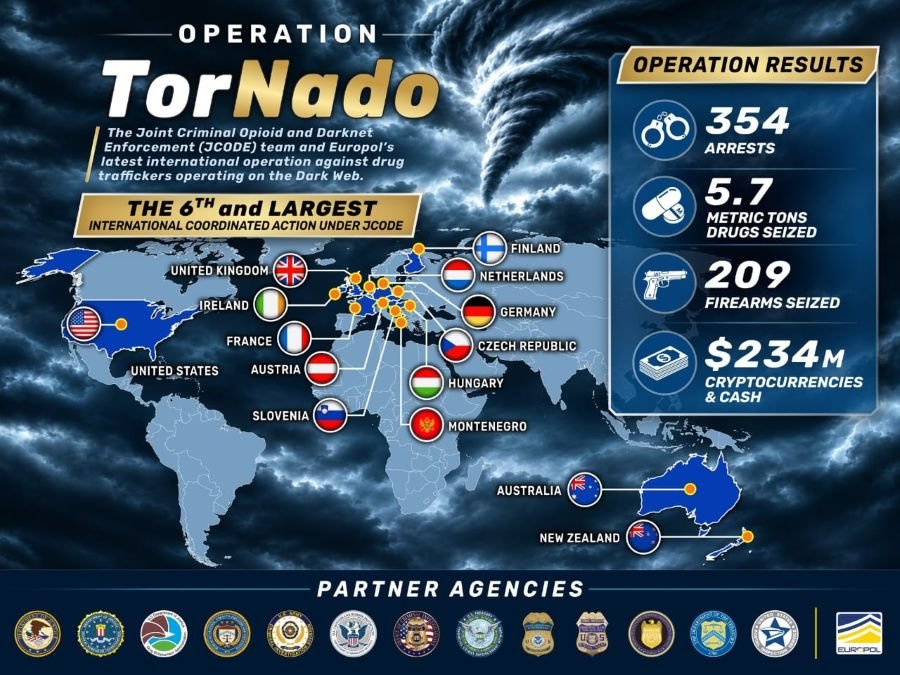
In one of the largest international crackdowns on dark web drug trafficking to date, law enforcement agencies across the United States, Europe, Australia, and New Zealand have arrested 354 individuals and seized more than $234 million in cash and cryptocurrency.
The operation, known as Operation TorNado, was announced on November 12, 2026, by the U.S. Department of Justice (DOJ) in collaboration with Europol. It represents the largest coordinated takedown of dark web narcotics vendors and buyers in the history of the Joint Criminal Opioid and Darknet Enforcement (JCODE) initiative.
Beyond the arrests and financial seizures, authorities recovered approximately 5.7 metric tons of illegal drugs, including fentanyl, heroin, cocaine, methamphetamine, ecstasy, and other dangerous substances. Investigators also seized 209 firearms and 38 pill presses.
The results highlight how international law enforcement agencies are increasingly working together to identify criminal networks operating behind anonymous online accounts and dismantle the infrastructure supporting illegal drug distribution.
What Is Operation TorNado?
Operation TorNado is a coordinated international law enforcement initiative targeting criminal organizations that use dark web marketplaces to sell and distribute illegal drugs, particularly fentanyl and other opioids.
Led through the U.S. Department of Justice’s Joint Criminal Opioid and Darknet Enforcement (JCODE) team, the operation brought together multiple federal, state, and international agencies.
The investigation ran from May 2025 through October 2026, with authorities using intelligence gathered from previous dark web marketplace takedowns to identify individuals involved in online drug trafficking.
According to the DOJ, investigators were able to connect anonymous vendor accounts to real individuals suspected of selling illegal products through dark web marketplaces.
The operation builds on previous international enforcement efforts, including Operation RapTor in 2025, Operation SpecTor in 2023, Operation Dark Huntor in 2021, and Operation DisrupTor in 2020.
However, Operation TorNado stands out as the most extensive coordinated action in JCODE’s history since the initiative was established in 2018.
354 Arrests Across Multiple Countries
One of the most significant outcomes of Operation TorNado was the arrest of 354 individuals suspected of participating in dark web drug trafficking and other online criminal activities.
The arrests were carried out across several countries, demonstrating the international reach of the investigation.
According to figures released by the U.S. Department of Justice, the arrests were distributed as follows:
- United States: 132 arrests
- United Kingdom: 59 arrests
- Hungary: 45 arrests
- Germany: 41 arrests
- France: 23 arrests
- New Zealand: 13 arrests
- Netherlands: 12 arrests
- Slovenia: 11 arrests
- Austria: 6 arrests
- Ireland: 5 arrests
- Czechia: 4 arrests
- Australia: 2 arrests
- Finland: 1 arrest
The coordinated enforcement actions targeted individuals believed to be operating as dark web drug vendors, buyers, and other participants in illicit online marketplaces.
Europol also reported hundreds of house searches and investigative actions conducted as part of the operation.
Importantly, investigations are still ongoing, as authorities continue working to identify additional individuals behind suspicious dark web accounts.
More Than $234 Million in Cash and Cryptocurrency Seized
Financial seizures were another major achievement of Operation TorNado.
Authorities recovered more than $234 million in cash and virtual currencies believed to be connected to criminal activities.
The financial crackdown demonstrates the importance of following money trails when investigating online criminal organizations.
Although dark web marketplaces often rely on cryptocurrency transactions and anonymous accounts, investigators increasingly use blockchain analysis, financial intelligence, and international information-sharing systems to identify suspicious transactions and connect digital activity to individuals.
Europol confirmed that its specialists played an important role in analyzing blockchain transactions and identifying financial connections between suspects.
The agency also reported that European authorities seized more than €60 million in cash and cryptocurrencies, while U.S. authorities recovered more than $166 million in criminal assets.
These financial investigations are particularly important because disrupting the money behind illegal marketplaces can make it harder for criminal organizations to continue operating.
Nearly Six Tonnes of Illegal Drugs Recovered
Operation TorNado was not limited to financial investigations. Authorities also removed substantial quantities of dangerous substances from circulation.
Approximately 5.7 metric tons of illegal drugs were seized worldwide during the operation.
The substances recovered included:
- Fentanyl and other synthetic opioids
- Methamphetamine
- Heroin
- Cocaine
- Ecstasy
- MDMA
- Other controlled substances and counterfeit pharmaceutical products
Investigators also recovered 38 pill presses and 209 firearms.
The seizure of pill presses is particularly significant because these machines can be used to manufacture counterfeit pharmaceutical tablets, which may contain highly potent synthetic opioids.
Counterfeit pills can pose serious public health risks because buyers may have little or no knowledge of the substances or quantities contained in them.
The operation therefore targeted not only the online sale of illegal drugs but also parts of the physical infrastructure used to manufacture, package, and distribute them.
Dark Web Marketplaces Under Investigation
Operation TorNado also relied on intelligence obtained from previous dark web marketplace takedowns.
Investigators focused on identifying vendors and buyers who had been active on several prominent platforms, including:
- Archetyp
- Bohemia
- Nemesis
- Kingdom
- Tor2Door
- DrugHub
Following previous marketplace disruptions, law enforcement agencies were able to examine information and intelligence that helped identify suspected criminal operators.
Authorities used investigative techniques, digital forensics, financial analysis, and international intelligence-sharing arrangements to connect online accounts with real-world identities.
The investigation also extended beyond traditional dark web marketplaces to include vendor shops, online forums, and encrypted messaging services.
This approach reflects a broader shift in cybercrime investigations: rather than focusing exclusively on shutting down websites, authorities are increasingly targeting the people, financial networks, and distribution systems that allow illegal online businesses to operate.
Several Major Criminal Investigations Uncovered
The U.S. Department of Justice also highlighted several individual investigations connected to Operation TorNado.
In Florida, two brothers, Stanislav Chernyshov and Vladislav Chernyshov, were arrested over allegations that they operated a dark web vendor account known as BarbaraWhite.
Investigators allege that the operation distributed counterfeit oxycodone pills containing highly potent nitazenes. According to prosecutors, the network was connected to more than 1,000 parcels shipped across 49 states.
In another investigation, Alexander Green was arrested over allegations that he operated an online drug trafficking organization known as STARLABS.
Authorities linked the operation to the distribution of several illegal substances, including fentanyl, through the Drughub dark web marketplace.
Other investigations involved suspected vendors distributing methamphetamine, heroin, cocaine, counterfeit pharmaceutical products, MDMA, and other controlled substances.
These cases demonstrate that dark web drug trafficking is not simply an online problem. Behind anonymous accounts are physical supply chains, manufacturing facilities, storage locations, financial transactions, and individuals responsible for moving illegal products to buyers.
The defendants remain presumed innocent unless proven guilty in court.
How International Agencies Coordinated the Crackdown
The scale of Operation TorNado required cooperation between numerous law enforcement and investigative organizations.
In the United States, participating agencies included the FBI, Drug Enforcement Administration (DEA), Homeland Security Investigations (HSI), Internal Revenue Service Criminal Investigation (IRS-CI), U.S. Postal Inspection Service, and other federal partners.
Europol played a central role in coordinating international intelligence-sharing and supporting investigations across participating countries.
Its specialists provided operational assistance, forensic expertise, and blockchain analysis to help investigators identify suspects and financial connections.
Other international partners included the Australian Federal Police, the United Kingdom’s National Crime Agency, Germany’s Federal Criminal Police Office, France’s National Gendarmerie, New Zealand Police, and law enforcement authorities across several European countries.
By sharing intelligence and coordinating investigations, these agencies were able to pursue suspects across national borders and connect criminal activities that might otherwise have been investigated separately.
What Operation TorNado Means for the Future of Dark Web Crime
The results of Operation TorNado send a clear message to individuals who believe that operating behind anonymous online accounts makes them invisible to law enforcement.
While dark web marketplaces provide a degree of anonymity, they do not eliminate the digital, financial, and physical evidence that criminal investigations can uncover.
Cryptocurrency transactions, shipping records, seized devices, communications, and information obtained from disrupted marketplaces can all help investigators build cases against suspected offenders.
The operation also demonstrates why international cooperation has become increasingly important in tackling cyber-enabled drug trafficking.
A vendor may operate in one country, receive cryptocurrency payments from buyers in another, and arrange for illegal products to be shipped across several international borders.
Investigating these networks requires agencies to work beyond traditional geographical boundaries.
For law enforcement, the challenge will be ensuring that the disruption of one marketplace does not simply lead to the emergence of another.
Final Thoughts
Operation TorNado represents a major development in the international fight against dark web drug trafficking.
With 354 arrests, more than $234 million in seized cash and cryptocurrency, approximately 5.7 metric tons of illegal drugs recovered, and hundreds of weapons and manufacturing tools confiscated, the operation has significantly disrupted several suspected criminal networks.
However, the investigation is far from over. Authorities are continuing to identify individuals connected to dark web vendor accounts and pursue additional leads.
https://www.darkowl.com/blog-content/holiday-shopping-on-the-dark-web-the-myths-vs-the-reality/
Ultimately, Operation TorNado highlights an important reality of modern cybercrime enforcement: the dark web may provide criminals with tools to conceal their identities, but coordinated international investigations can still expose the people and organizations operating behind the screens.