



Lithuanian law enforcement authorities have dismantled one of the largest synthetic drug production laboratories ever uncovered in the Baltic States, following a major police operation near Vilnius. The investigation has revealed an alleged industrial-scale drug manufacturing operation, resulting in the seizure of hundreds of kilograms of illegal substances and the arrest of four suspects.
Among those detained is a Dutch citizen of Turkish origin who investigators suspect of organising the laboratory's establishment and coordinating its illegal activities alongside three Lithuanian nationals.
The discovery represents a significant development in the fight against organised drug crime in Europe and highlights the scale of international criminal networks operating across national borders.
Massive Drug Laboratory Discovered Near Vilnius
The large-scale synthetic drug laboratory was discovered in premises located in the Vilnius district of Lithuania.
According to the Lithuanian Criminal Police Bureau, the facility was allegedly operating on an almost industrial scale, producing substantial quantities of synthetic drugs.
Deputy Chief of the Lithuanian Criminal Police Bureau Saulius Briginas described the operation as unprecedented in the region, pointing to the laboratory's size, production capacity and the quantity of illegal substances discovered.
Police investigations suggest that the facility had been established to manufacture synthetic drugs in significant quantities, potentially supplying markets beyond Lithuania.
The operation involved more than 60 law enforcement officers, with searches and investigative activities continuing for over three days.
More Than 800 Kilograms of Drugs Seized

One of the most significant aspects of the investigation was the enormous quantity of illegal substances recovered by authorities.
Preliminary figures released by Lithuanian prosecutors indicate that investigators seized:
- More than 500 kilograms of methamphetamine.
- More than 300 kilograms of amphetamine.
- Approximately 4.5 kilograms of synthetic cathinone 3-CMC.
- More than 3,000 litres of BMK, a chemical precursor used in synthetic drug production.
Authorities estimate that the recovered substances could represent more than four million individual doses.
The quantities recovered underline the seriousness of the suspected criminal operation and the potential impact it could have had on illegal drug markets across Europe.
Investigators have also indicated that the final quantities could change as forensic examinations of the seized materials continue.
Dutch Citizen of Turkish Origin Suspected of Organising the Operation
One of the central developments in the investigation concerns the suspected organiser of the laboratory.
According to prosecutors, one of the individuals suspected of organising the illegal production operation is a citizen of the Netherlands of Turkish origin.
Investigators believe he coordinated the establishment and activities of the laboratory in Lithuania, working alongside three Lithuanian nationals.
The four individuals have been formally identified as suspects in connection with the investigation into organised criminal activity and the handling of particularly large quantities of narcotic and psychotropic substances.
Two of the suspects have reportedly been remanded in custody.
Authorities have not established criminal guilt through a final court judgment, and the investigation remains ongoing.
International Drug Supply Network Under Investigation
The investigation has uncovered evidence suggesting that the suspected criminal group operated an international supply network involving laboratory equipment, chemical substances and the distribution of manufactured drugs.
According to Lithuanian prosecutors, suppliers from China, India and several European countries were allegedly involved in providing laboratory equipment and chemical substances.
Investigators also believe that some materials were purchased from specialised suppliers operating within Lithuania.
The suspected distribution network may have extended well beyond the Baltic region.
Countries identified by investigators as possible destinations for the manufactured substances include:
- The Netherlands
- Germany
- Belgium
- Czech Republic
- Other European markets
These findings suggest that the laboratory may have been part of a wider international organised crime operation rather than an isolated manufacturing facility.
Police Intercept 17 Kilograms of Drugs Destined for Czech Republic
The investigation also led to the prevention of a suspected drug-smuggling attempt.
During the operation, Lithuanian authorities intercepted cargo handled by a logistics company after discovering two plastic containers holding approximately 17 kilograms of amphetamine crystals.
The shipment was reportedly intended for transportation to the Czech Republic.
The seizure represents another important part of the investigation, demonstrating how authorities are examining not only the production facility but also the alleged distribution and transportation channels connected to the suspected network.
More Than €200,000 in Cash Discovered
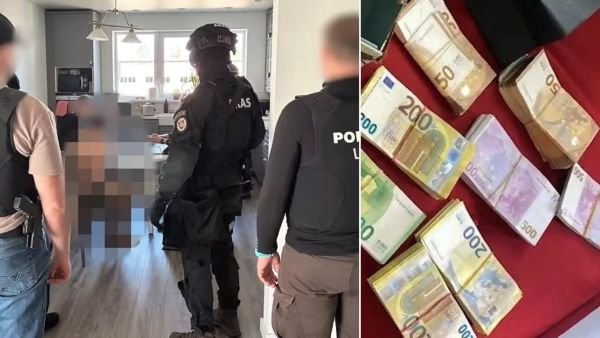
Investigators also reportedly discovered more than €200,000 in cash during searches connected to the laboratory.
The discovery adds another dimension to the investigation into the group's suspected financial activities.
Authorities are continuing to examine the origin of the money, the acquisition of laboratory equipment and the financial relationships potentially connected to the alleged international operation.
A Major Blow to Organised Drug Crime in the Baltic States

The dismantling of the laboratory represents a significant achievement for Lithuanian law enforcement and its efforts to combat organised drug production.
The investigation demonstrates the growing importance of international police cooperation in identifying criminal supply chains, tracing chemical purchases and preventing synthetic drugs from reaching European markets.
With hundreds of kilograms of illegal substances seized and four suspects identified, the operation could have disrupted a substantial drug manufacturing and distribution network.
However, investigators are still working to establish the full extent of the alleged criminal activities, identify additional connections and determine the complete scale of the operation.
What Happens Next?
The Lithuanian investigation remains ongoing, with prosecutors and police continuing to examine the evidence recovered during the operation.
Investigators are expected to focus on identifying other potential members of the suspected network, tracing the international supply of chemicals and laboratory equipment, and establishing the intended destinations of the manufactured substances.
Under Lithuanian law, offences involving particularly large quantities of narcotic and psychotropic substances can carry prison sentences of up to 18 years, depending on the specific charges and circumstances.
The suspects remain entitled to the presumption of innocence until proven guilty by a court.
Conclusion
The discovery of one of the largest synthetic drug laboratories in the Baltic States marks a major development in the fight against organised crime in Europe.
With more than 800 kilograms of methamphetamine and amphetamine seized, thousands of litres of chemical precursors recovered and four suspects detained, Lithuanian authorities have dealt a significant blow to an alleged international drug production network.
The suspected involvement of a Dutch citizen of Turkish origin has also brought attention to the cross-border nature of the investigation.
As authorities continue their work, further details may emerge about the suspected organisation, its international connections and the intended distribution of the drugs.